







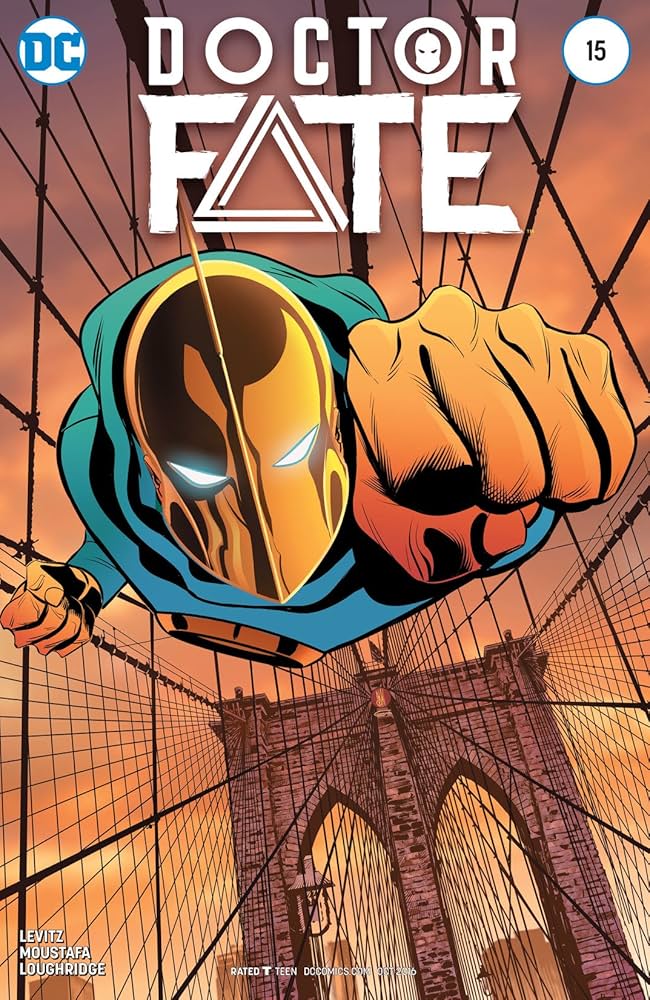
Paul Levitz’ 2015 retelling of the story of Doctor Fate worked to incorporate the classic DC character with the popular concept of having a teenager or immature character get stuck with the great power and responsibility that they’re not quite ready for. Characters like Spider-Man, Batman Beyond, Shazam, Blue Beetle, and more appeal to a young adult audience because it allows them to imagine what it would be like if they had these gifts. That idea has kept teen and young adult demographics interested in legacy comics for a long time. The idea of early comics was to give people a hero to look up to (e.g. Superman, Captain America). These legacy comics allow imaginative younger readers to look up to what they could be as they see another teenager doing amazing things (and more importantly, doing what’s right).
Khalid Nassour is a 22 year old Brooklyn Med student of an Egyptian-American background. When all major cities on Earth begin flooding supernaturally, he is led to an Egyptian History & Mythology Museum, wherein he receives the magical helmet of the ancient deity Nabu. The helmet grants him mystical powers in addition to a magical sight that allows him to see the world for what it really is. He can see that the flooding and chaos is caused by Anubis as he tries to restore the Ma’at, and that there are people all around who know more than they let on.
This comic goes heavily into the Egyptian Mythology side of Doctor Fate, as opposed to the commonly done “unknown mystics” like how he works in Justice League or JSA media. I feel that this makes the character very much like a more magical version of Moon Knight, at least in this particular comic. Both sides of Doctor Fate, whether mysterious or explained, allow for such an interesting and diverse set of magical abilities that never fail to amaze.
Interestingly, the magic of the helmet is changed slightly in this series from how it normally works. Doctor Fate has changed a lot since his creation in 1940, but the general idea in modern interpretations is that when Kent Nelson, an archaeologist, wears the helmet of Fate, his body is taken over by Nabu, one of the Lords of Order, and he takes a back seat. In the 2015 comic, however, Khalid Nassour is fully in control with Nabu occasionally speaking to him. I definitely think that this was the way to go with this retelling, because the entire point of a legacy character like what we see here is to see an inexperienced kid try to be a hero. If Doctor Fate is just the all-wise and magical Lord of Order, there’s no point to Khalid or his character growth as he faces these challenges.
A very prominent aspect of this comic is Khalid dealing with the split in his faith. His father is an Egyptian Muslim, and his mother is an American Christian, meaning he’s not only mixed in ethnicity (a subject brought up extensively), but also battling between what is all true (meeting Egyptian gods in the middle of that also does not help). This all builds on his confusion that he has to work through as he gains these new powers and his life changes completely. The author continues these themes throughout the series, making political points through the characters about Muslim representation in America. Despite this, he is still able to put the fictional superhero action at the forefront and tell an entertaining story.
All around, I feel that this comic definitely had some ups and downs, but the art style was very neat and the action was entertaining. It was cool to see a more nature/energy-focused side of Doctor Fate’s powers (such as controlling the winds and seas), rather than unknowable interdimensional mumbo jumbo (though that is still very awesome). Doctor Fate is one of my favorite characters, and it’s super fun to see other writers’ ideas for what could be done with a generally mysterious character.