
















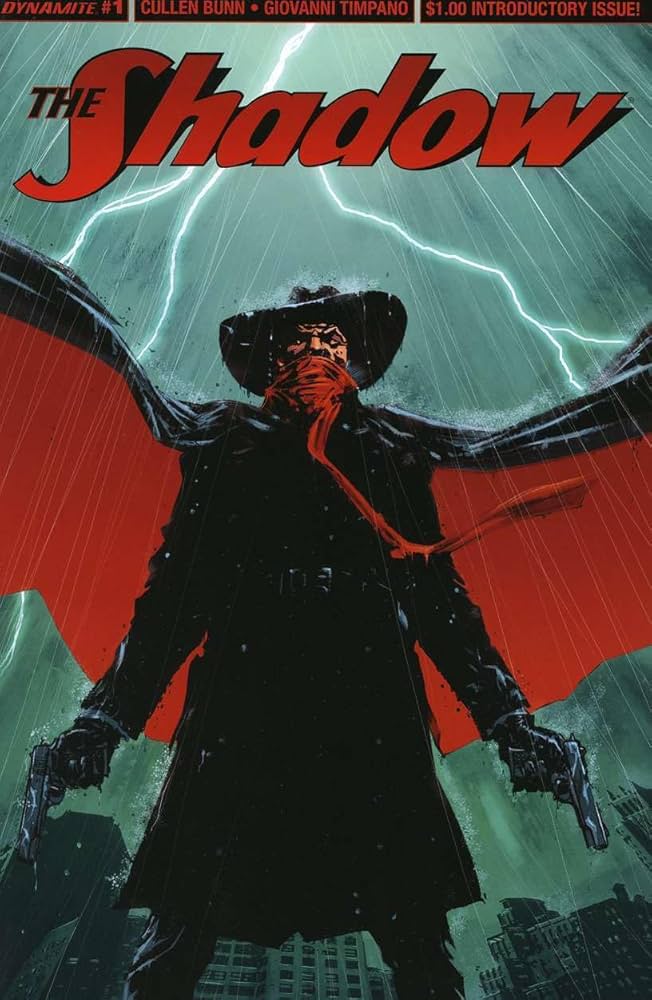
Often, in comic book media, you will see movie and television adaptations based on an original comic book. Superman or Batman, for example, with early comic appearances in the 1930’s, have been made into entire franchises. The Shadow, however, did it almost backwards. He appeared in radio shows and magazines before officially debuting as a “comic book character.” That change of course occurred due to the popularization of superhero comics in the late 1930’s and early 40’s. Today, he is Dynamite Comics’ gritty detective with a foggy history who uses his great skill and double pistols to uncover secret evils.
The character of “The Shadow” first appeared on July 31, 1930 as the narrator of a radio show called Detective Story Hour. He was a mysterious detective with ambiguous powers who would guide the listener through the mission he was working on. The show had its foundations in the works of Street & Smith publications, specifically their stories from Detective Story Magazine. Essentially, these pulp magazines were comics before comics, primarily taking the form of short stories involving mysteries, dramas, or westerns. The purpose of the radio show was to boost the views of the magazines, but it instead had the opposite effect. Street & Smith found that viewers were more captivated by the radio show and The Shadow as a narrator than they were by the detective stories in the magazines. The publication even reported that fans would ask pulp magazine vendors specially for “The Shadow Detective Magazine,” even though the detective magazines never featured The Shadow as a character.
Noticing this public interest, Street & Smith commissioned Walter B. Gibson (who is generally credited with the creation of the modern adaptation of the character) to write stories involving The Shadow. For the next 20 years, under the pen-name of Maxwell Grant (who was said to be one of The Shadow’s aliases), Gibson produced almost novel-length stories twice a month starring The Shadow. Based on the further success of these novels, a second radio drama, this one officially titled The Shadow, was created in 1937, which only boosted the demand and love for the character. Over time, the character developed into more books and short stories, and the radio show was phased out as new television media became popular. Eventually, having already been a part of small comic strips and pulp magazines, the character of The Shadow was obtained by Dynamite Comics in 2011. This secured him as the official comic book character he is known as today, as the magazines and novels were cemented in history as “old ways of entertainment.”
Dynamite continued with the character, restating his origin and integrating him into their already popular comic universe. From 2012 to present, he has been in a multitude of reboots, team-ups, miniseries, and now an ongoing series from 2015. In 2014, The Shadow was included in a crossover series with other Dynamite characters. Namely, The Green Hornet and his sidekick Kato, Zorro, and The Spider. His solo series such as Matt Wagner’s The Shadow: Year One focus on his checkered past and follow him through more modern mysteries and conflicts. His actual powers are somewhat different in the comics than they were in the original radio shows, but his detective skillset and pistols remain the same. Normally, he has the hypnotic ability to “cloud men’s minds,” essentially blinding them or making himself invisible, though many writers choose not to use this ability for their own differing reasons.
The Shadow (nor Dynamite Comics as a whole) is not as popular today as major publishers like DC, Marvel, or Image, but he is definitely a fan-favorite for those who do know of him. The idea of a dark detective is nothing if not abundant (seen in characters like Batman or The Question), but The Shadow brings his own uniqueness to the table. Not to mention the fact that technically he was a character nearly a decade before Batman was. The Shadow even had his own fear-factor that he struck into his enemies, just like Batman is now often known for. Primarily, this took place in the form of his lethal weapons and mysterious lurking– that the wrongdoers would not know where he was, and once they did, it may be too late. The other form of his fear factor, however, is in the opening line of every episode of his radio show, which I will leave you with now:
“Who knows what evil lurks in the hearts of men? The Shadow knows!”

Dan and Ramona Walker • Apr 6, 2026 at 2:17 pm
The radio show had a reboot in the 70s and was quite a dramatic show in that format. It was well worth a listen.